

Do Conservatories Fall Under Permitted Development? Building Regulations and Permitted Development for Conservatories Explained
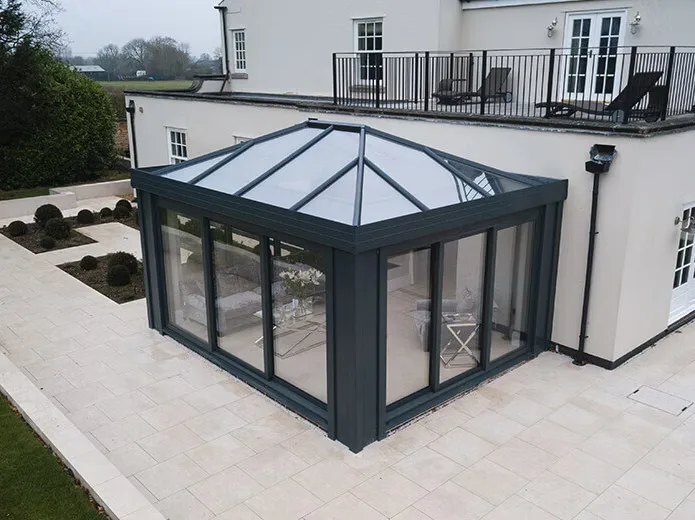
The purpose of this blog post is to explain the building regulation requirements and permitted development status of conservatories and conservatory replacements. If you’re looking to enhance your home with a new conservatory, you’ve come to the right place! We construct bespoke home extensions for all homeowners. Read on to find out if conservatories fall under permitted development & learn more about building regulations for home extensions.
Are There Building Regulations For A New Conservatory?
Thankfully, a conservatory is an exempt building under Regulation 9(1) and Schedule 2 Class 7 of the Building Regulations (2010) as amended, and is, therefore, exempt from building regulations.
However, there is no statutory definition of a conservatory, and some of the more popular modern designs for a ‘conservatory would be more properly classified as an extension which would, therefore, have to be compliant with building regulations. Under the MHCLG Divisional Circular Letter ‘Conservatories and Porches’ (30 July 2013), a document which provides guidance on the interpretation of building regulations for inspectors, a conservatory will normally qualify for an exemption if:
1- It is on the ground level
2- It must not exceed 30m 2 of internal floor area
3- It must be ‘substantially glazed’ – this is commonly interpreted in industry practice to be around 75% of the roof as glass and around 50% of the walls.
4- Thermal separation is maintained between the house and the conservatory (i.e. existing external doors remain in place).
5- The heating system is not extended.
If your conservatory or conservatory replacement does not comply with all the above points it is most likely to be classified as an extension and not as a conservatory, and therefore, will need to comply with full building regulations. Most home extensions that we build at Allgood Construction require full building regulations. However, we are more than happy to build conservatories for customers that want them and you will find several examples of conservatories that we have built for customers on this page. Many older conservatories were originally built as exempt structures under building regulations. However, when replacing a conservatory, particularly when installing a solid roof system or removing the thermal separation (i.e. the external doors between the conservatory and home) that exemption is lost.
In this situation, the structure is likely to be treated as a home extension and then must comply with building regulations.
Do Conservatories Fall Under Permitted Development?
A conservatory will usually fall under Class A of your permitted development rights. We have a deep dive available here and we would encourage you to read the Government technical guidance documents available here. The short version is that you will most likely be able to build up to 3 metres off the back of your house if you are a semi-detached or terrace house, and 4 metres off the back if you are a detached house. You will also be able to extend to the side 50% of the width of the original house.
So long as your project complies with your permitted development rights, then you will not require planning permission.
Can I Extend My Existing Conservatory Under Permitted Development?
Extending old conservatory bases to allow for a larger conservatory is a common request from our customers, and there are a few things to consider when looking at
extending the base. The first is the quality of the existing base. As conservatories are an exempt building under building regulations, there are substantial variations in the quality of the base. It is not uncommon to find older bases which lack sufficient depth to be structurally sound, lack insulation and have no damp proof coursing. In such cases, our recommendation is to remove the base and start with a fresh, well-built foundation to ensure maximum longevity for your project.
The second common issue is regulatory ambiguity, specifically under section 11.3 of Approved Document L Conservation of Fuel and Power Volume 1: Dwellings, 2021 edition incorporating 2023 amendments. This section states that where a thermal element is renovated and this constitutes a ‘major renovation’ (this is defined as where more than 25% of the surface area of the external building envelope is renovated) then the whole of the thermal element must be improved. There are some building inspectors who will interpret this section as requiring that the existing conservatory base will have to be improved as a result of extending the base. However, other building inspectors will not view extending the base as renovating the existing thermal element. This is a matter of ambiguity in the regulation.
As a matter of routine, we will always engage with the building inspector on their expectations to ensure that we have absolutely clarity on whether we will need to alter the base or not.
Why Should You Replace Your Conservatory?
Older conservatories often suffer from poor thermal performance, condensation and ventilation issues, and a dated appearance. Often, buyers treat them as a project to be dealt with, rather than adding value to your home they can subtract it. Simply swapping the roof system can introduce new issues. As a consequence of older conservatories not being built under building regulations, there is a high likelihood that the conservatory foundations is not going to be adequate for a traditional brick extension. This would require either underpinning the foundations, or removing the base and starting from scratch, both adding additional cost into your jobs.
There are some exceptions that we do come across when we visit customers jobs, especially in the case where conservatories were build at the same time as the original house and therefore has the same foundations. However, this is not the case for the majority of cases that we encounter. Where we have foundations which are properly insulated, well-built and damp proof coursing, we would usually use Ultraframe’s Hup! Extension System. We are network installer for this system, and where a conservatory base is otherwise good but cannot withstand the weight of a brick extension, we always recommend the Hup! System.
Hup! Is precision engineered using Structural Insulated Panels (SIPs) to give you proper wall construction, structural integrity designed for solid roof loads, and predictable compliance with building regulation requirements. Due to the lightweight nature of Hup! We can usually use older conservatory bases to save cost, without compromising of the quality of the extension.
There are additional advantages. For instance, because the thermal performance of the Hup! System is superior to brick, they are thinner than a traditional extension wall and usually provide between 10-15% greater internal space compared to a traditional extension.
Disclaimer: These blog posts reflect the experience and opinion of our organisation as primary contractors working in the construction sector. We are not Registered Building Control Approvers, legal professionals, planning professionals or affiliated with any Local Planning Authority. We will always recommend that our customer seek guidance from their Local Planning Authority on all matters relating to planning permission or building regulations and it is your responsibility to do so.
Recent News
16 July 2026
How Are Doors Kept Secure? | A Homeowner’s Guide
8 July 2026
Can You Paint uPVC Windows and Doors?
2 July 2026
What Do Window Energy Ratings Mean for Your Home?
29 May 2026
French vs Sliding vs Bifold doors – Which is Better for the Back of Your House?